
NCERT Class 9 revised syllabus: For years it has been a common tradition among students to inherit books from their siblings or other senior students when they enter a new class. Since new books take time to come to the market, students usually try to get acquainted with the syllabus of their new class with the old books. Many students also buy secondhand books from the market. While this was the norm for all these years, from the session of 2026-27, this tradition will lead to a delusion. If you are a student of class 8 who is expecting to graduate to class 9 in the coming academic session, the previous editions of textbooks will be largely irrelevant for you.
THE REASON?
NCERT has recently revised the syllabus of class 9. Today in this article we will give a detailed analysis of what changes have been incorporated in the new syllabus. Read along.
As per the revised draft syllabus for class 9 released by NCERT, the changes incorporated are not just a minor update but a fundamental restructure of what will be taught to you and how you will be assessed. This blog post aims to educate you and make you dive deep into every major change that is incorporated in these subjects—mathematics, science, English, and social science.
Table of Contents
STRUCTURE OF THE NEW CURRICULUM
The new syllabus drafted by NCERT is not just a list of subjects; it is indeed a structured framework divided into 3 distinct parts which are designed in such a way that students are imparted education in a more holistic manner.
Part 1: The Language Core
In the language section covers four primary languages : English, Hindi, Urdu and Sanskrit
Part 2: The Academic Core
The Academic Section covers the main pillar subjects of secondary education : Mathematics, Science and Social Science.
Part 3: Holistic & Vocational Areas
This part of the curriculum covers certains subjects through which emphasis has been given in the well-rounded development. This part comprises 4 areas : Individuals in Society, Vocational Education, Art Education, and Physical Education & Well-being.
SUBJECT-WISE ANALYSIS OF THE NEW REVISED SYLLABUS
Mathematics
The total number of subjects of Mathematics has been increased from 12 to 15. This increase does not mean you will have to study more. Instead advanced concepts have been introduced in the subject. Several topics from Class 10, 11 and even 12 have been brought down to Class 9. This migration of senior topics include:
- Arithmetic Progression(AP) : This topic was previously taught in Class 10.
- Areas Related to Circles : Previously taught in Class 10
- Pair of linear equations in two variables: Previously taught in Class 10.
- Geometric Progression (GP): Previously this topic was taught in class 11, now introduced in class 9.
Apart from these, the chapter Polynomials has been split into two separate chapters which will help students in more focused study of its various components. Along with this changes, NCERT has introduced a two-level assessment system in Mathematics.
1. Proficiency Level: This is a mandatory level for all students which ensures a baseline understanding of all mathematical concepts.
2. Advanced Level: This level is optional for students who want to pursue higher studies in Mathematics in the future.
In order to incorporate this changes in the subject, NCERT is designing new textbooks in order to cater both the level of assessment. These textbooks will serve as the right resource for students regardless of the path they choose.
Science
Though the number of chapters of Science has been reduced from 12 to 11, the depth and focus of the content has been shifted toward application of the concepts. This change has been brought to incorporate a sense of practical understanding among the students instead of rote learning. Lets have a look at the changes brought in the sub-branches of the subject.
1) PHYSICS : The Gravitation chapter has been deleted from the Physics section , making the total number of chapters in this section to 4 from 5. However, the chapter “Work and Energy” has been expanded and renamed “Work, Energy and Simple Machines”. Simple machines like Pulleys, Inclined planes, and levers have been introduced in this chapter.
2) CHEMISTRY: The total number of chapters in the Chemistry section has been reduced to 3 from 4. The introductory chapter “matter in Our Surroundings” has been completely removed from the Class 9 syllabus.
3) BIOLOGY: Unlike other sections, Biology has seen an increase in the number of chapters from 3 to 4. Though the chapter “Improvement in Food Resources” has been deleted from the syllabus, two new chapters “Reproduction” and “Diversity” have been added.The chapters like “Cell” and “Tissue” have been updated with topics of modern biology.
Social Science
The chapters of class 9 have undergone a significant reduction from 20 to 16. However, this decrease of chapters does not mean the essence and relevance of the subject has been reduced. Instead the content has been modernized to include more practical and ancient topics.Lets have a look at the detailed changes that have been introduced.
HISTORY : A shift in timeline is seen in the chapters of history of class 9 NCERT Social Science book. The draft revised syllabus of the History section of Social Science starts from Early human History and covers major developments up to 1200 CE. interestingly chapters that were earlier part of class 12 syllabus like Harappan Culture and Bhakti Traditions are now included in the Class 9 NCERT book.
GEOGRAPHY: Several topics included in class 11 are now part of the class 9 syllabus of Geography section. The topics which are migrated from class 11 are –
- Plate Tectonics.
- Interior and Composition of the Earth.
- Ocean Relief and Biomes Distribution.
POLITICAL SCIENCE : High level concepts like Justice, Authority and Elections which were formerly included in class 11 are now part of class 9.
ECONOMICS: In the subject Economics stress has been given to introduce students toward practical financial literacy instead of theory. Students will now be taught topics like budgeting, income tax, and investment options. These topics will give students real world skills they can use beyond the classroom.
English
The subject of English has received a complete facelift. Previous textbooks “Beehive” and “Moments” have been replaced with a single, completely new book titled “Kaveri.” Apart from the name of the book, the literature section of the book is made to accommodate new stories and poems. However, the grammar section remains intact.
The writing skill segment of English has seen significant updates. New topics are included such as:
a) Persuasive essays.
b) Literary Analysis.
c) Research Writing.
d) Creative Writing.
The whole idea behind introduction of this renewed writing skill segment is to equip students with modern writing skills and introduce higher-order academic and critical thinking skills in their education.
ADVICE TO STUDENTS FOR 2026-27 SESSION
Class 9 is an important grade for every student. The transition from class 8 to class 9 is always a challenge. With the major changes incorporated in the syllabus, students are required further more preparation to step into the new class.
- Donot buy old books: The old resources will be largely irrelevant after the changes and hence buying or referring to the old books will be futile. However, since you have now got an idea about the changes, you can now refer to the unchanged portion of the textbooks, if you are curious to learn the subject before going to the new class.
- Focus on application: The new syllabus emphasis on applying the concepts to the real world. And hence rote learning or memorizing the concepts will not fetch results; instead try to understand the concepts.
- Prepare for higher difficulty : Several higher-level topics like AP, GP, Plate Tectonics are migrated from upper classes to class 9 syllabus. Students should mentally prepare for this higher difficulty before entering into the new class.
The two level assessment system: This unique assessment system introduced in the subject mathematics requires a better understanding. If you enjoy the subject Mathematics, you should opt for the advanced level option to build a strong foundation for competitive exams later on. However, if your mathematical skills are average, you can opt for the proficiency level and focus on other subjects that will benefit you in your future career.
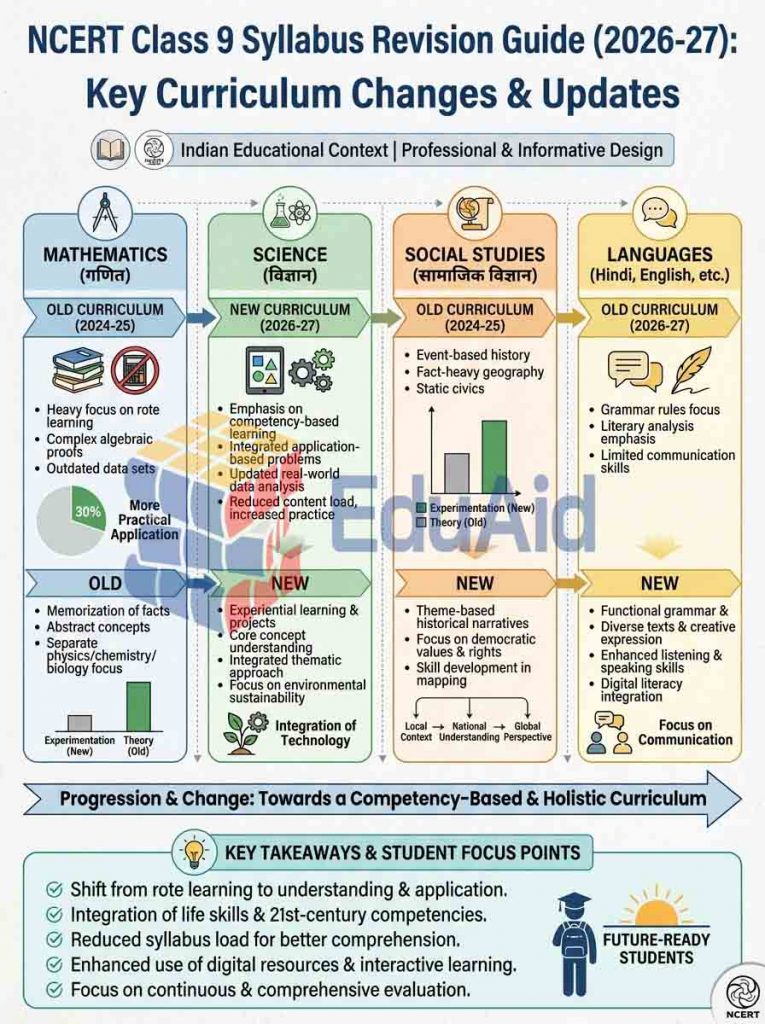
Before we wrap up, let’s have a look at this infographic that explains all the nitty-gritty of the revised syllabus
CONCLUSION
The revision of the class 9 NCERT syllabus to be introduced from 2026-27 academic is a more practical, bold and rigorous education system.The new curriculum aims in preparing students for 21st century challenges. If you are in class 8 and staying updated with this new information of the changed curriculum of class 9 makes you already one step ahead of your competition. HAPPY learning!